top of page
ARCHI
PORTFOLIO BY LYNETTE LAW

PROJECT 1 : PERSONAL SPACE FOR THE ELDERLY
Project 1 deals with user experience that requires students to design a personal space which is intended for a specific user based on an in-depth study of the user's need. It is to develop awareness of environmental sustainability in a design and student's ability to meet the imperative and inter-related social needs. In addition, the project will prepare students to programmatic requirements of specific group of users for Project 2.
The learning outcomes of this project includes but not limited to the following:
- being able to identify and analyse environmental qualities and contextual needs of a site; such as human environment within an architectural space
- being able to apply ideas of environmental sustainability learned throughout the other modules and precedent studies
- being able to design and create architectural spaces with consideration of environment poetics in relation to the basic natural context and existing built context
FINAL BOARD AND MODEL

 |  |
|---|---|
 |  |
 |  |
 |  |
PROJECT 2A : SITE ANALYSIS
( CENTER FOR THE ELDERLY )

The second project of this module comes in two parts, whereby the first part requires us to come up with a site analysis of our site as a group.
Our site is located in Taman Kanagapuram along the Old Klang Road in Selangor. It is surrounded by housing estates, religious facilities, apartments and low rise commercials. It possesses the characteristics of a good neighbourhood with normal range of community facilities around it. The topography of the site is almost level which is considered appropriate for an elderly to minimize the need for steep walks, stairs or ramps. Such topography encourages walking, which is a highly desirable exercise for elderlies.
PROJECT 2B : CENTER FOR THE ELDERLY
The final part of this project aims to provide a design for an elderly care centre at Taman Kanagapuram. The project requirements are as follow:
- spatial typology: clustered
- building height: 2-3 storeys
- approximate floor area: 800 sq m.
- facilities: entry, lobby, lounge, café, entertainment and social space, recreation and exercise space, library and reading rooms, meditation or prayer rooms, caretaker office and accommodation, staff area
Also, we were to consideration of access for the disabled, public and private accesses and separation, and also pedestrian accesses into and around the site.
The final submission requirements were four A1 panels and one physical model.
To overcome the negative elements found from the site after in depth analysis, such as illegal squatters that become a crime prone area, unmaintained bridge, lack of shading causes not much residents to roam around the area and lack of interaction between the community themselves. This relates to how an elderly is conceive with negative thoughts like how they are useless and unappreciated by the society as the age and they are not fond of communicating with each other and others too.
As to overcome all these negativity coming from not only the site itself but also the elderly, it gave me inspiration to overcome through therapy by using 5 senses. In order to achieve my design intention, I've looked into how negative spaces ( corridors ) can be transformed into positive spaces - functional spaces that are able to enhance interaction and also create a special form / element that can help the elderly to identify the space. Other than focusing on the form and interior spaces, I've also focus on creating landscapes such as water elements and trees to give a warm and natural feeling to the elderly and make them feel comfortable.
The learning outcomes of this project are as follow:
- applying ideas of environmental sustainability in design
- design and create architectural spaces with consideration of environmental poetics in relation to the basic natural context and existing built context which impact on users' experiences
- combine the environmental needs, the site, and the users' experiences within simple building design in the open landscape
- being able to produce both 2D and 3D drawings, modelling and verbal presentation to communicate and visualize architectural design and ideas based on clustered spatial typology.
INTERIM BOARD

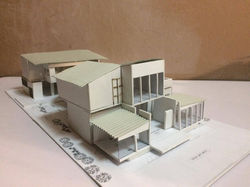
FINAL BOARD AND MODEL


 |  |
|---|---|
 |  |
 |
bottom of page